Beyond the Basics: Choosing Between GUI and CLI Git Clients for Advanced Workflows
Master complex Git workflows! This article on GitAndVersionControlHub.com helps you choose between GUI and CLI Git clients, guiding you towards the best…
Read article
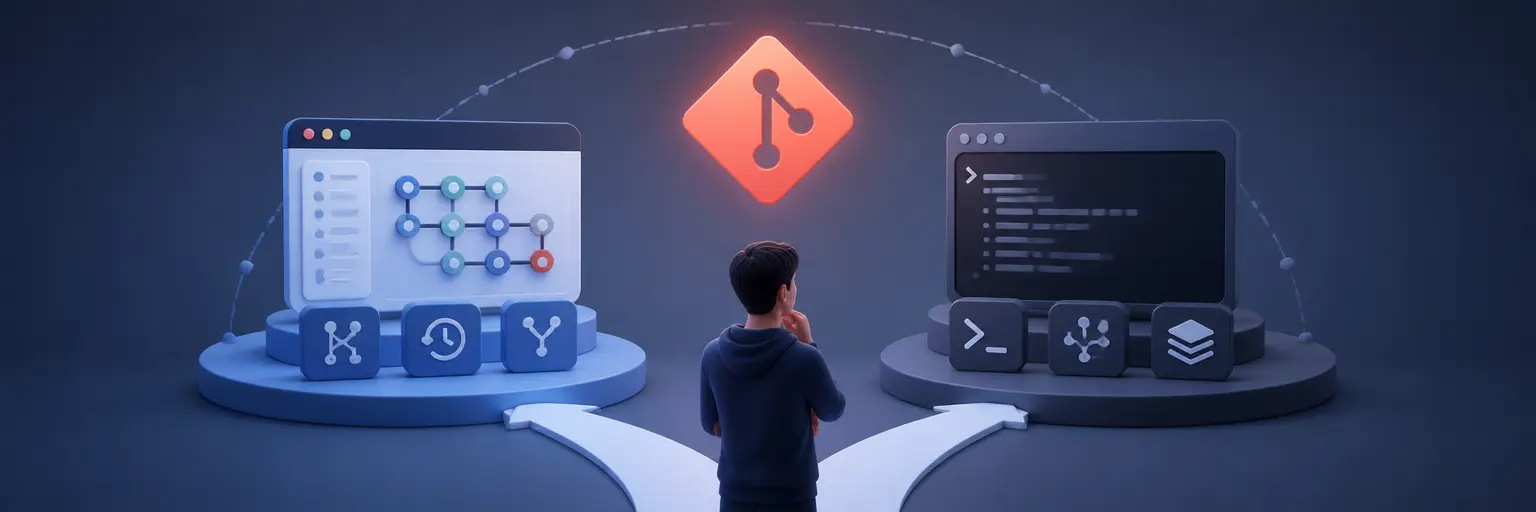
Find the best Git client for your workflow with practical guidance on GUI vs. command-line tools, feature comparisons, usability, platform support, and real-world reviews. Whether you need visual branch management, streamlined GitHub and GitLab integration, or powerful CLI control, discover the right solution to improve version control, collaboration, and developer productivity. 🚀
Master complex Git workflows! This article on GitAndVersionControlHub.com helps you choose between GUI and CLI Git clients, guiding you towards the best…
Read article
Master efficient workflows with Git staging area management tips! This GitAndVersionControlHub.com article compares staging area handling across popular Git clients, boosting your…
Read article
Unlock your open-source potential! GitAndVersionControlHub.com shows you the best Git client for contributors, streamlining your workflow for seamless collaboration on community projects.…
Read article
Choosing the right Git client significantly impacts developer productivity and satisfaction. GitAndVersionControlHub.com helps you identify the best Git client for developers, boosting…
Read article
Master easy Git branching and merging with GitAndVersionControlHub.com's expert tutorials. Simplify complex Git operations and boost your development workflow, from beginner to…
Read article
Supercharge your development workflow! GitAndVersionControlHub.com shows you how to customize your Git client for developers, optimizing your experience with expert tips and…
Read article
Efficiently resolve Git merge conflicts using either graphical user interfaces (GUIs) or the command-line interface (CLI). GitAndVersionControlHub.com explores diverse Git conflict resolution…
Read article
Master Git's power visually! GitAndVersionControlHub.com explores the benefits of GUI clients, guiding you to the Best GUI Git clients 2023 for streamlined…
Read article
Choosing your first Git client can be daunting. This guide on GitAndVersionControlHub.com helps you decide between GUI and CLI interfaces, highlighting the…
Read article
Switching Git clients? GitAndVersionControlHub.com's guide provides a seamless transition, walking you through each step to effortlessly migrate between Git clients and maintain…
Read article
Streamline your workflow with GitAndVersionControlHub.com's guide to seamlessly integrating CI/CD pipelines. Discover the best Git clients for CI/CD, optimizing your automation and…
Read article
Master Git on the go! GitAndVersionControlHub.com reviews the best mobile Git clients, empowering developers to manage their projects anytime, anywhere. Boost your…
Read articleChoosing the right Git client can make version control faster, clearer, and more reliable. This guide from Git and Version Control Hub compares graphical Git clients and command-line tools, helping developers select the best Git workflow for personal projects, professional teams, GitHub, GitLab, branching, merging, rebasing, and CI/CD development environments. Explore Git client features, usability, platform support, repository management, collaboration tools, and performance before deciding which solution fits your experience level and project requirements.
GUI Git clients provide an accessible way to manage repositories through visual interfaces rather than terminal commands. Users can inspect commit histories, stage individual files or lines, create branches, resolve merge conflicts, review pull requests, and compare changes with clear menus and graphical representations. This makes a graphical Git client especially useful for beginners, designers, technical writers, and developers who prefer visual feedback.
When reviewing a Git GUI, consider branch visualization, interactive staging, merge conflict tools, commit search, diff readability, GitHub and GitLab integration, and repository performance. Popular options may include GitKraken, Sourcetree, Fork, GitHub Desktop, SmartGit, and IDE-integrated Git tools. The best GUI Git client should reduce friction without hiding important Git concepts from the user.
The Git command line remains the most flexible and widely supported way to work with repositories. Commands such as git clone, git add, git commit, git branch, git merge, git rebase, and git push work across operating systems and development environments. Command-line Git is particularly valuable for automation, remote servers, containers, scripts, and CI/CD pipelines.
CLI workflows offer precise control, repeatable commands, powerful scripting, and access to advanced Git features. Developers working with complex branching strategies, multiple remotes, hooks, submodules, or automated deployment systems often benefit from mastering Git in the terminal. Although the learning curve can be steeper, command-line knowledge transfers easily between editors, operating systems, and hosting platforms.
The choice between a GUI and CLI depends on your goals, experience, team practices, and project complexity. A GUI can simplify repository navigation and make visual tasks such as reviewing diffs or resolving conflicts easier. The CLI is often faster for experienced users and more practical when repeating commands, managing many repositories, or connecting Git operations to scripts.
Many developers achieve the best results with a hybrid Git workflow. They may use a graphical client for commit history, code review, and conflict visualization while relying on the terminal for rebasing, automation, advanced branch management, and CI/CD troubleshooting. Learning both approaches improves Git understanding and makes it easier to work with different teams and tools.
A thorough Git client comparison should examine more than appearance. Look for support for local and remote repositories, visual commit graphs, staging controls, side-by-side diffs, stash management, tags, cherry-picking, rebasing, merge tools, submodules, worktrees, and repository search. These features can significantly affect productivity when working on large codebases or complex Git histories.
Also evaluate GitHub integration, GitLab support, pull request workflows, SSH authentication, credential management, signing support, accessibility, extensions, keyboard shortcuts, and cross-platform compatibility. Teams should consider licensing, security policies, onboarding time, and whether the client works well with existing IDEs and development tools.
Git client reviews are most useful when they explain who a tool is designed for rather than simply listing features. Beginners may prefer a clean interface, helpful explanations, and simple branch management. Experienced developers may prioritize speed, advanced rebase controls, custom workflows, terminal integration, and support for large repositories.
Before selecting a tool, test it with a realistic project. Create branches, make commits, inspect differences, simulate a merge conflict, connect to GitHub or GitLab, and review the authentication process. A practical evaluation reveals whether the software offers reliable performance, understandable workflows, and the right balance between convenience and Git control.
Teams should select Git tools that support consistent collaboration and reduce workflow confusion. A suitable client should work with the team’s branching model, code review process, protected branches, issue tracking, and remote repository provider. Integration with GitHub and GitLab can simplify pull requests, merge requests, notifications, and repository authentication.
Organizations should also consider security, access controls, SSH keys, single sign-on, audit requirements, and onboarding resources. Standardizing one tool is not always necessary, but documenting recommended GUI and CLI workflows helps developers collaborate effectively while preserving flexibility for personal preferences.
The best Git client for beginners is one with a clear interface, visual commit history, simple staging controls, and helpful conflict-resolution features. GitHub Desktop, Sourcetree, and similar GUI tools can be approachable starting points, while learning basic Git commands alongside the interface builds stronger long-term skills.
Neither option is universally better. A GUI is often easier for visual repository management and reviewing changes, while the CLI provides speed, portability, scripting, and advanced control. Many developers use both depending on the task.
Yes. Most modern Git GUI clients support remote repositories hosted on GitHub and GitLab through HTTPS or SSH. Check whether the client supports pull requests, merge requests, authentication methods, and organization security requirements before choosing it.
Important features include reliable diff tools, interactive staging, branch visualization, conflict resolution, rebase and cherry-pick support, repository search, SSH authentication, remote hosting integration, performance with large repositories, and compatibility with team workflows and CI/CD systems.
Yes. Understanding core CLI commands makes it easier to troubleshoot problems, follow team documentation, use remote servers, automate tasks, and work in CI/CD environments. A GUI can improve productivity, but command-line knowledge provides a portable foundation for effective version control.