
Git and Kubernetes for DevOps: Version Control for Container Orchestration

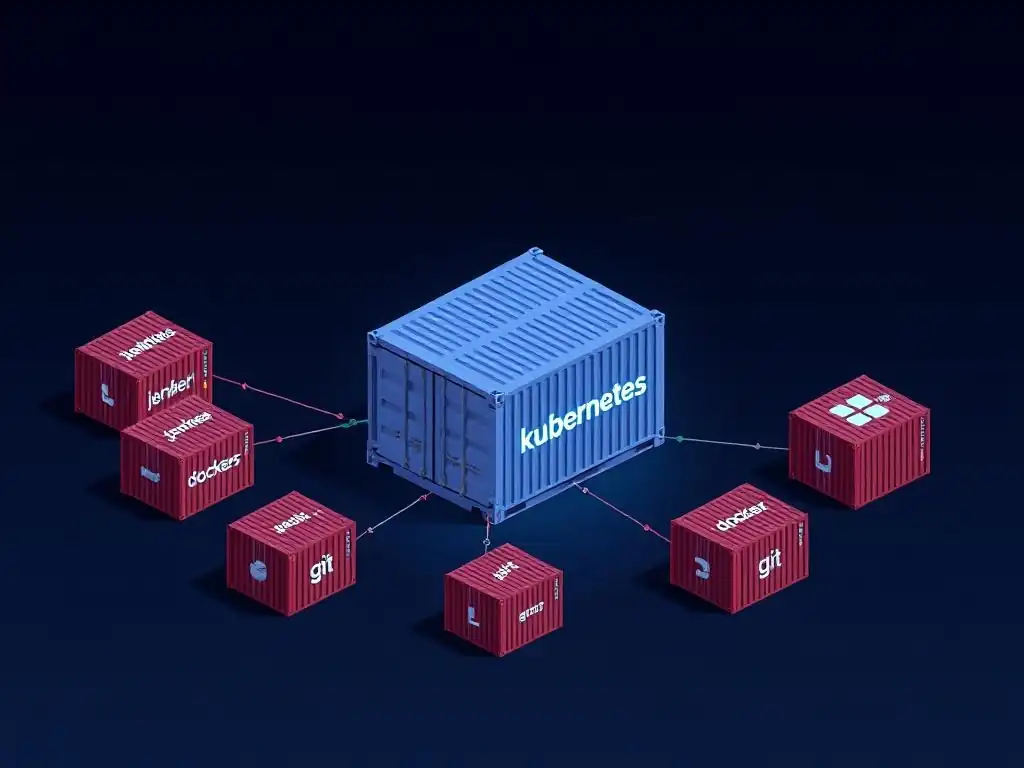
Welcome to Git and Version Control Hub, your central resource for unlocking the power of Git!
Are you ready to bridge the gap between version control and container orchestration? Dive into our in-depth exploration of Git Kubernetes DevOps integration and discover how to streamline your workflow. Learn practical strategies for leveraging Git within your Kubernetes deployments, boosting efficiency and collaboration. Curious how these tools can revolutionize your DevOps pipelines? Let's find out...
- Introduction to Git, Kubernetes, and DevOps
-
Frequently Asked Questions
- What is the primary benefit of using Git with Kubernetes in a DevOps workflow?
- How does Git help with managing Kubernetes deployments?
- What role does version control play in a Git Kubernetes DevOps integration?
- Can Git be used to manage CI/CD pipelines for Kubernetes applications?
- What are some common tools used for Git Kubernetes DevOps integration?
- Final Reflection: Orchestrating the Future with Git and Kubernetes
- Supercharge Your DevOps: Claim Your Container Control!
Introduction to Git, Kubernetes, and DevOps
Understanding the DevOps Philosophy
DevOps is more than just a set of tools; it's a cultural philosophy centered around bringing development and operations teams together to improve collaboration and accelerate the software development lifecycle. At its core, DevOps aims to break down traditional silos between these teams, fostering a shared responsibility model where everyone is involved from the initial planning stages through to deployment and ongoing operations. This collaborative environment encourages faster innovation, quicker feedback loops, and more reliable software releases.
For instance, companies like Netflix, a pioneer in DevOps adoption, have demonstrated the power of this philosophy. By embracing DevOps principles, Netflix achieves thousands of deployments daily, showcasing the agility and speed that can be unlocked.
This rapid deployment cadence is crucial for staying competitive and responsive to user needs in today's fast-paced digital landscape. The focus is on automation, continuous integration, and continuous delivery (CI/CD) pipelines to minimize manual intervention, reduce errors, and ensure consistent and predictable software releases.
DevOps also emphasizes a culture of continuous improvement. This means constantly monitoring performance, gathering feedback, and iterating on processes and tools to optimize workflows. Feedback loops are critical, allowing teams to quickly identify and resolve issues, and learn from both successes and failures. Consider the example of Etsy, another early adopter of DevOps.
They famously implemented "blameless postmortems" after incidents, focusing on learning from mistakes rather than assigning blame. This approach fosters a safe environment for experimentation and encourages teams to proactively identify and mitigate risks. By embracing DevOps, organizations can achieve greater agility, faster time-to-market, improved software quality, and enhanced operational efficiency. The integration of Git, Kubernetes, and DevOps practices is a natural evolution in this journey, providing powerful tools to realize these benefits in modern software development.
The Role of Git in DevOps Workflows
Git plays a pivotal role in DevOps workflows, serving as the backbone for version control and collaboration. In a DevOps environment, where speed and reliability are paramount, Git provides the necessary infrastructure to manage code changes efficiently and track every modification made to the codebase. Imagine a scenario where multiple developers are working on different features simultaneously. Git's branching and merging capabilities allow teams to work in parallel without stepping on each other's toes.
Each feature can be developed in isolation on its own branch, and then seamlessly integrated back into the main branch when ready. This parallel development drastically reduces development time and increases productivity. Platforms like GitHub and GitLab, built on Git, further enhance collaboration with features like pull requests and code reviews, ensuring code quality and knowledge sharing among team members.
Beyond code versioning, Git's commit history provides a comprehensive audit trail of all changes. This is crucial for traceability and accountability in DevOps. Every commit includes information about who made the change, when, and why, offering invaluable insights for debugging, understanding code evolution, and ensuring compliance.
In a DevOps context, this audit trail extends beyond code to infrastructure as code (IaC). Tools like Terraform and Ansible, often used in DevOps, can have their configurations versioned in Git, providing the same level of control and traceability for infrastructure changes as for application code. Furthermore, Git's distributed nature enhances resilience.
Every developer has a complete copy of the repository, minimizing the risk of data loss and ensuring business continuity. This distributed model is particularly beneficial in DevOps, where uptime and availability are critical concerns. Git's robust version control, collaboration features, and audit capabilities make it an indispensable tool for enabling efficient and reliable DevOps workflows.
Kubernetes: An Overview of Container Orchestration
Kubernetes, often abbreviated as K8s, is an open-source container orchestration platform that automates the deployment, scaling, and management of containerized applications. In the context of DevOps, Kubernetes provides a robust and scalable infrastructure to run and manage applications built using containers like Docker. Consider a modern microservices architecture, where applications are broken down into smaller, independent services packaged as containers. Managing these containers manually would be incredibly complex and error-prone.
Kubernetes steps in to automate tasks such as container deployment, scaling based on demand, load balancing across containers, health checks, and self-healing. For example, if a container fails, Kubernetes automatically restarts it, ensuring high availability and resilience. This automation frees up DevOps teams to focus on higher-level tasks like application development and feature delivery, rather than being bogged down by infrastructure management.
Kubernetes operates on a declarative configuration model. You define the desired state of your application and infrastructure in configuration files (typically YAML manifests), and Kubernetes works to achieve and maintain that state. This declarative approach aligns perfectly with the Infrastructure as Code (IaC) principles of DevOps.
Key components of Kubernetes include pods (the smallest deployable units, containing one or more containers), deployments (which manage the desired state of pods), and services (which expose applications running in pods). Large organizations like Google, who originally developed Kubernetes, and smaller startups alike rely on Kubernetes to manage their containerized applications at scale. By abstracting away the complexities of underlying infrastructure, Kubernetes enables DevOps teams to build and deploy applications faster, more reliably, and at scale, making it a cornerstone technology in modern DevOps practices.
Frequently Asked Questions
What is the primary benefit of using Git with Kubernetes in a DevOps workflow?
Using Git with Kubernetes allows for infrastructure as code, enabling you to manage and version control your Kubernetes configurations just like your application code. This ensures consistency and reproducibility across environments.
How does Git help with managing Kubernetes deployments?
Git stores the declarative configuration files for Kubernetes, such as YAML manifests. This allows you to track changes, revert to previous versions, and collaborate on deployment strategies, leading to improved deployment reliability.
What role does version control play in a Git Kubernetes DevOps integration?
Version control provides a single source of truth for your Kubernetes configurations. It enables auditing of changes, facilitates collaboration among team members, and simplifies rollback procedures in case of deployment failures.
Can Git be used to manage CI/CD pipelines for Kubernetes applications?
Yes, Git triggers automated CI/CD pipelines when changes are pushed to the repository. This automates the build, test, and deployment process to Kubernetes, resulting in faster and more reliable releases.
What are some common tools used for Git Kubernetes DevOps integration?
Common tools include GitLab CI/CD, GitHub Actions, and specialized tools like Flux and Argo CD, which are GitOps operators that automatically synchronize Kubernetes clusters with Git repositories, promoting continuous delivery.
Final Reflection: Orchestrating the Future with Git and Kubernetes
The journey through Git and Kubernetes, as tools for DevOps, reveals a powerful synergy that is not merely theoretical but a tangible force shaping modern software development. The ability to version control infrastructure as code, manage deployments with precision, and automate the entire lifecycle is no longer a luxury; it's a necessity for organizations striving for agility and resilience in today's rapidly evolving landscape. This integration is the cornerstone of efficient DevOps practices, and its impact is only set to grow.
The influence of Git and Kubernetes extends far beyond the technical realm, fundamentally altering the cultural landscape of software teams. This shift towards collaborative, iterative development, driven by version control and container orchestration, fosters a sense of shared responsibility and empowers developers to take ownership of the entire application lifecycle. The future of DevOps is about removing silos and fostering collaboration. Git and Kubernetes, when used together, are powerful enablers of this vision.
This ongoing evolution demands continuous learning and adaptation, but the rewards – increased efficiency, reduced errors, and faster time to market – are undeniable.
As you navigate the complexities of modern software development, remember the principles of version control and container orchestration. Embrace the power of Git and Kubernetes to build robust, scalable, and resilient applications. Consider how you can leverage these tools to foster collaboration, automate your workflows, and ultimately, deliver exceptional value to your users. The future of software development is being written now, line by line, commit by commit, deployment by deployment. Be a part of shaping that future.
Supercharge Your DevOps: Claim Your Container Control!
Thank you for diving into the world of Git and Kubernetes! We hope you've gained valuable insights into how these powerful tools can streamline your container orchestration and version control workflows. Now, it's time to put that knowledge into action!
Here are a few things you can do right now:
- Immediately begin implementing a Git-based workflow for your Kubernetes configurations. Don't wait, even starting with a small, non-critical deployment will give you invaluable practical experience.
- Explore alternative GitOps tools like ArgoCD or Flux. They can automate the deployment process and offer advanced features for managing complex Kubernetes environments.
- Share this article with your DevOps team and discuss how you can collaboratively improve your container management strategies.
What specific Kubernetes configuration are you most excited to start version controlling with Git? Let us know in the comments!