
From BitKeeper to Git: The Licensing Dispute That Changed Version Control Forever

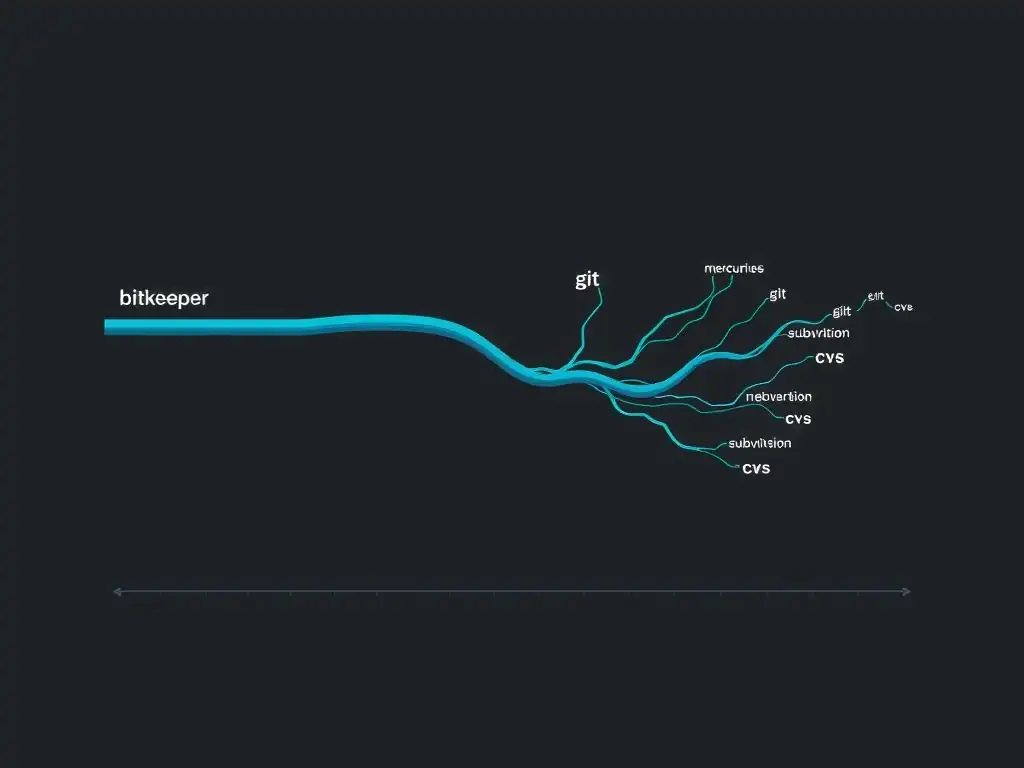
Welcome to Git and Version Control Hub, your central resource for mastering the art of code management! Ever wonder how we got to the powerful version control systems we use today? Dive into our latest article, "From BitKeeper to Git: The Licensing Dispute That Changed Version Control Forever," to uncover the surprising history of version control systems and the pivotal moment that shaped the future of collaborative development. Discover the drama, the innovation, and the lasting impact – a story that will forever change how you view Git. Intrigued? Read on to unlock the secrets!
From BitKeeper to Git: The Licensing Dispute That Changed Version Control Forever
- The Pre-Git Era: Understanding Version Control Before Git
- The BitKeeper Era: A Controversial Partnership
- The Cracks Appear: Licensing Issues and Disagreements
- The Birth of Git: Necessity as the Mother of Invention
- Git vs. BitKeeper: A Comparison of Architectures and Philosophies
- The Impact of Git on Version Control History
- Legacy of BitKeeper: Lessons Learned in Version Control History
- Git's Continued Evolution: Building on the Foundation
-
Frequently Asked Questions
- How did the BitKeeper licensing dispute lead to the creation of Git?
- What were the primary advantages of Git over existing version control systems at the time of its creation?
- How did the licensing change of BitKeeper impact the Linux kernel development workflow?
- What role did GitHub and GitLab play in the popularization of Git?
- Is Git considered a centralized or distributed version control system, and why is that significant?
- Final Reflection: The Enduring Legacy of Open Collaboration
- Unleash Your Git Potential Now!
The Pre-Git Era: Understanding Version Control Before Git
Centralized Version Control Systems: Subversion and CVS
Before Git revolutionized the landscape, centralized version control systems (CVCS) dominated software development. Systems like Concurrent Versions System (CVS), initially released in the late 1980s, and Subversion (SVN), which emerged as a successor to CVS in 2000, were widely adopted. These systems operated on a client-server model, where a central repository held the project's entire history, and developers checked out working copies to their local machines.
All changes were then committed back to this central repository. This approach, while offering a structured way to manage code changes, presented limitations, particularly in terms of speed, offline work, and branching capabilities. For instance, in a CVCS, every operation, including viewing history or committing changes, required network connectivity to the central server.
Subversion, aiming to address some of CVS's shortcomings, improved upon its predecessor by introducing atomic commits and better handling of binary files. However, the fundamental centralized architecture remained. Imagine a team of developers working across different geographical locations using SVN.
If the central server experienced downtime or network issues arose, the entire team's ability to collaborate and commit code would be severely hampered. Furthermore, branching and merging, while possible in systems like SVN, were often cumbersome and error-prone, leading to what many developers termed "merge hell." These limitations paved the way for the exploration of more distributed and flexible version control methodologies.
BitKeeper's Rise: A Proprietary Solution Gains Traction
In the late 1990s and early 2000s, while open-source CVCS solutions like CVS and Subversion were prevalent, proprietary version control systems also existed. One such system that gained significant traction, especially within large-scale software development projects, was BitKeeper, developed by BitMover, Inc. BitKeeper distinguished itself by offering superior performance and a more robust feature set compared to many of its contemporaries. It was designed to handle very large repositories and support distributed development workflows more effectively than traditional CVCS. Companies facing the challenges of managing massive codebases and geographically dispersed teams found BitKeeper particularly appealing.
BitKeeper's architecture, although still conceptually centralized in some aspects, incorporated features that hinted at distributed version control. It allowed for a more decentralized workflow compared to CVS or Subversion, offering features like "changesets" that facilitated easier branching and merging. Its performance, especially in handling large repositories and complex operations, was a key selling point. Notably, BitKeeper was offered under a unique licensing model that, for a period, allowed open-source projects, including the Linux kernel, to use it for free. This strategic decision significantly boosted BitKeeper's visibility and adoption within the open-source community, despite its proprietary nature.
The BitKeeper Era: A Controversial Partnership
BitMover and the Linux Kernel: A Mutually Beneficial Relationship
The adoption of BitKeeper by the Linux kernel development community in 2002 marked a significant moment in the history of version control systems. Linus Torvalds, the creator of Linux, and many core kernel developers recognized the limitations of existing open-source version control systems when dealing with the scale and complexity of the Linux kernel project. BitKeeper, with its performance and advanced features, seemed like an ideal solution to manage the kernel's rapidly growing codebase and the distributed nature of its development. This partnership was initially beneficial for both BitMover and the Linux kernel project.
For BitMover, the Linux kernel's adoption of BitKeeper was a major endorsement and a significant marketing win. It showcased BitKeeper's capabilities in handling one of the largest and most active open-source projects in the world. For the Linux kernel developers, BitKeeper provided a much-needed upgrade from the then-used, less efficient methods of patch management and rudimentary version control. It streamlined collaboration, improved workflow efficiency, and allowed for more sophisticated branching and merging strategies within the kernel development process. This collaboration, however, was built on a somewhat fragile foundation due to the proprietary nature of BitKeeper and its licensing terms.
BitKeeper's Features: Distributed Functionality and Performance
BitKeeper, while not fully distributed in the way Git is, offered functionalities that were a step towards distributed version control and addressed key pain points of centralized systems. One of its standout features was its performance, particularly when handling large repositories and complex histories. Operations that could be slow and cumbersome in CVS or Subversion were significantly faster in BitKeeper. This performance advantage was crucial for the Linux kernel development, which involved frequent commits and a vast codebase.
Furthermore, BitKeeper introduced concepts like "changesets" that facilitated more flexible branching and merging workflows. While still relying on a central repository as the source of truth, BitKeeper allowed developers to work more independently and manage changes in a more granular manner compared to traditional CVCS. It also offered advanced features for visualizing and analyzing project history, which were valuable for understanding the evolution of the Linux kernel. These features, combined with its performance, made BitKeeper a compelling choice for large, distributed development teams, even though it was a proprietary solution in a predominantly open-source world.
The Cracks Appear: Licensing Issues and Disagreements
The Andrew Tridgell Incident: Reverse Engineering Attempts
The seemingly smooth partnership between BitMover and the Linux kernel community began to unravel due to licensing concerns and philosophical differences surrounding open source versus proprietary software. A pivotal moment that triggered the conflict was the actions of Andrew Tridgell, a prominent figure in the Samba project and the broader open-source community.
Tridgell, concerned about the Linux kernel's reliance on a proprietary tool and the potential for vendor lock-in, began attempting to reverse engineer the BitKeeper protocol. His goal was to create an open-source tool that could interoperate with BitKeeper repositories, ensuring that the Linux kernel community wouldn't be entirely dependent on BitMover's proprietary solution.
Tridgell's efforts, while driven by open-source principles, were perceived by BitMover as a violation of their license agreement, which prohibited reverse engineering. Although Tridgell maintained that he was not directly reverse engineering BitKeeper itself but rather observing its behavior to understand its protocol, BitMover viewed his actions as a direct threat to their intellectual property and business model. This incident escalated tensions and ultimately led to the breakdown of the licensing agreement between BitMover and the Linux kernel project.
BitMover Revokes the License: The End of an Era
Following the Andrew Tridgell incident and the ensuing accusations of reverse engineering, BitMover decided to revoke the free license for BitKeeper for the Linux kernel project. This decision marked the end of the BitKeeper era for Linux and sent shockwaves through the open-source community. The revocation was a significant blow to the Linux kernel developers who had become reliant on BitKeeper's features and performance for their daily workflow. It forced them to confront the immediate challenge of finding a replacement version control system that could meet their demanding needs.
The license revocation highlighted the inherent risks of relying on proprietary software, particularly for open-source projects that prioritize freedom and transparency. It also underscored the philosophical clash between proprietary and open-source development models. The Linux kernel community was left in a precarious situation, needing to quickly transition away from BitKeeper while ensuring minimal disruption to the ongoing kernel development. This necessity became the catalyst for the creation of Git, arguably one of the most impactful version control systems in the history of software development.
The Birth of Git: Necessity as the Mother of Invention
Linus Torvalds' Vision: A New Approach to Version Control
Faced with the loss of BitKeeper, Linus Torvalds took on the challenge of creating a new version control system tailored to the specific needs of the Linux kernel project. Torvalds had a clear vision: he wanted a system that combined the performance and some of the distributed capabilities of BitKeeper but was entirely open source and free from the licensing restrictions that had led to the BitKeeper debacle. He famously stated that he needed a version control system that was "fast like hell" and could handle the massive scale of the Linux kernel repository.
Torvalds' vision was not simply to replicate BitKeeper's functionality in an open-source package. Instead, he aimed to rethink the fundamental approach to version control, drawing inspiration from BitKeeper's strengths while addressing its limitations and proprietary nature. He envisioned a system that was truly distributed, allowing for greater flexibility and resilience, and one that prioritized speed, data integrity, and efficient handling of branching and merging. This vision laid the foundation for Git's innovative architecture and its subsequent widespread adoption.
Git's Design Principles: Speed, Data Integrity, and Distributed Architecture
Git was designed with several core principles in mind, directly addressing the shortcomings of existing systems and the specific requirements of the Linux kernel development. Speed was paramount. Torvalds wanted Git to be significantly faster than any existing open-source alternative, especially for common operations like commits, branching, and merging. This focus on speed was crucial for maintaining developer productivity within the fast-paced Linux kernel development environment.
Data integrity was another fundamental principle. Git was designed to ensure that the history of changes was reliably tracked and protected against corruption. This was achieved through cryptographic hashing of all objects within the repository, ensuring that any alteration to the history would be immediately detectable. Finally, distributed architecture was a key design decision.
Unlike centralized systems, Git was conceived as a distributed version control system (DVCS), where every developer has a complete copy of the repository, including its entire history. This distributed nature offered significant advantages in terms of speed, offline work, branching, and resilience. These core design principles made Git a revolutionary version control system that would soon transform software development practices.
Git vs. BitKeeper: A Comparison of Architectures and Philosophies
Distributed vs. Centralized: A Paradigm Shift in Version Control
The most fundamental difference between Git and BitKeeper lies in their architectural paradigms: Git is a distributed version control system (DVCS), while BitKeeper, although incorporating some distributed features, was fundamentally more centralized in its approach. In a DVCS like Git, every developer's local repository is a fully functional repository with the entire project history. This contrasts sharply with centralized systems where developers primarily interact with a single central repository. This distributed nature provides several key advantages.
Firstly, performance is significantly enhanced in a DVCS for many common operations. Since most operations in Git are performed locally against the developer's local repository, they are much faster and do not require network connectivity. Secondly, offline work becomes possible. Developers can continue to work, commit changes, and branch even without an internet connection, syncing their work later when connectivity is restored. Thirdly, branching and merging are more efficient and less prone to conflicts in a DVCS because they are primarily local operations.
Finally, DVCS offers greater resilience. If the central repository is lost or corrupted in a CVCS, the entire project history can be compromised. In Git, since every developer has a full copy, data loss is much less likely. This paradigm shift from centralized to distributed version control, spearheaded by Git, fundamentally changed how developers approached version control and collaboration.
Open Source vs. Proprietary: The Battle for Developer Freedom
Beyond the architectural differences, the clash between Git and BitKeeper also represented a broader philosophical battle between open-source and proprietary software models within the history of version control systems. BitKeeper, being proprietary, came with licensing restrictions and a lack of transparency in its inner workings. This model, while offering commercial support and potentially advanced features, often clashes with the open-source ethos of community contribution, transparency, and freedom from vendor lock-in.
Git, born out of the BitKeeper licensing dispute, was explicitly designed as an open-source project under the GNU General Public License. This open-source nature was not merely a matter of licensing; it was deeply ingrained in Git's development philosophy and community. Open source fostered collaboration, allowed for community contributions, and ensured that Git remained freely available and modifiable by anyone.
The Git vs. BitKeeper saga became a symbolic representation of the open-source movement's growing influence and its preference for transparent, community-driven solutions over proprietary alternatives, particularly in the realm of core development tools. This philosophical difference played a crucial role in Git's widespread adoption and the eventual decline of proprietary version control systems in many areas of software development.
The Impact of Git on Version Control History
The Rise of GitHub and GitLab: Democratizing Collaboration
Git's emergence as a powerful and open-source DVCS laid the foundation for a new era of collaborative software development. The distributed nature of Git, combined with its speed and efficiency, made it ideally suited for online collaboration platforms. This led to the rise of platforms like GitHub (founded in 2008) and GitLab (initially launched in 2011), which built their services directly on top of Git. These platforms provided web-based interfaces for managing Git repositories, facilitating code review, issue tracking, and project management, effectively democratizing access to sophisticated version control and collaboration tools.
GitHub and GitLab lowered the barrier to entry for version control, making it easier for individuals and teams of all sizes to collaborate on software projects, regardless of geographical location. They provided a centralized hub for distributed development, enabling open-source projects to flourish and commercial teams to streamline their workflows. The social coding aspect introduced by these platforms, with features like pull requests and forking, further enhanced collaboration and code sharing. The rise of GitHub and GitLab, directly enabled by Git, fundamentally transformed the landscape of software development and greatly expanded the reach and impact of version control systems.
Git's Influence on Modern Software Development Workflows
Git's impact extends far beyond the rise of GitHub and GitLab. It has profoundly influenced modern software development workflows and practices across industries. The speed, branching capabilities, and distributed nature of Git have enabled more agile and iterative development methodologies. Features like lightweight branching and merging have encouraged developers to adopt feature branching workflows, allowing for parallel development of new features and bug fixes without disrupting the main codebase.
Git has become an indispensable tool for continuous integration and continuous delivery (CI/CD) pipelines. Its ability to efficiently manage code changes and track history makes it ideal for automating build, test, and deployment processes. Furthermore, Git's distributed nature supports geographically distributed teams and remote work, which has become increasingly important in modern software development. Today, Git is the dominant version control system in the software industry, used by companies of all sizes, from startups to tech giants. Its influence on development workflows is undeniable, shaping how software is developed, collaborated on, and deployed in the 21st century.
Legacy of BitKeeper: Lessons Learned in Version Control History
The Importance of Open Source in Software Development
The BitKeeper saga provides a valuable lesson in the history of version control systems, particularly regarding the importance of open source in core software infrastructure. The Linux kernel's reliance on a proprietary tool like BitKeeper, while initially beneficial, ultimately proved to be a risky strategy. The licensing dispute and subsequent revocation highlighted the vulnerabilities of depending on closed-source software, especially for projects that value transparency, community involvement, and long-term sustainability.
The BitKeeper incident underscored the benefits of open-source solutions, which offer greater transparency, community support, and freedom from vendor lock-in. Git, born out of the need for an open-source alternative to BitKeeper, became a testament to the power of open-source collaboration and its ability to create robust and widely adopted tools. The experience with BitKeeper solidified the open-source movement's arguments for the use of open standards and open software, particularly in critical infrastructure components like version control systems. It illustrated that for core development tools, open source often provides a more resilient, adaptable, and trustworthy path forward.
How the BitKeeper Dispute Shaped Git's Development and Community
The BitKeeper dispute not only spurred the creation of Git but also profoundly shaped its development philosophy and community culture. The experience of being reliant on a proprietary tool with opaque licensing terms instilled in the Git community a strong commitment to open source principles, transparency, and community governance. This experience directly influenced Git's licensing (GPLv2), its development model, and the values that underpin its vibrant community.
The need to quickly replace BitKeeper also contributed to Git's rapid development and initial feature set. Linus Torvalds and the early Git developers focused on creating a system that was not only functional and performant but also robust and reliable, learning from both the strengths and weaknesses of BitKeeper.
The BitKeeper experience served as a constant reminder of the importance of developer freedom and the potential pitfalls of proprietary dependencies, shaping Git into the open, collaborative, and community-driven project it is today. In essence, the BitKeeper dispute was a crucible that forged Git's identity and its enduring commitment to open source values.
Git's Continued Evolution: Building on the Foundation
Scaling Git for Monorepos: Addressing Large-Scale Challenges
Even with its revolutionary design, Git continues to evolve to meet the ever-changing demands of modern software development. One significant area of ongoing development is scaling Git for monorepos, which are version control repositories that contain multiple projects or a very large codebase within a single repository. While Git excels at managing smaller, independent repositories, monorepos present unique challenges in terms of performance, storage, and usability. Companies with massive codebases, like Google, Facebook (now Meta), and Microsoft, often utilize monorepos for organizational and efficiency reasons.
Scaling Git for monorepos involves addressing issues such as repository size, commit history size, and the performance of operations like checkout and clone in extremely large repositories. Ongoing efforts include improvements to Git's core algorithms, the development of partial clone and sparse checkout features to reduce the amount of data downloaded, and the exploration of new storage backends and indexing techniques to enhance performance. These advancements aim to ensure that Git remains performant and scalable even for the largest and most complex software projects, extending its applicability to organizations managing massive codebases within a single repository.
Mastering Git for Modern Software Development
As Git continues to evolve, mastering its features and best practices remains crucial for modern software developers. Beyond basic commands like commit, push, and pull, modern software development often requires a deeper understanding of Git's advanced features, such as rebasing, interactive staging, submodule management, and Git workflows like Gitflow or GitHub Flow. Proficiency in these areas enables developers to leverage Git's full potential for efficient collaboration, streamlined workflows, and effective version control.
Furthermore, understanding Git's internals and data model, while not always necessary for day-to-day use, can be invaluable for troubleshooting complex issues and optimizing Git usage in specific scenarios. Continuous learning and adaptation are key in the ever-evolving landscape of software development tools. Mastering Git, with its ongoing advancements and its central role in modern software development, remains a critical skill for any developer seeking to be productive, collaborative, and effective in today's software engineering environment.
Frequently Asked Questions
How did the BitKeeper licensing dispute lead to the creation of Git?
The BitKeeper software, initially free for Linux kernel developers, became proprietary. This prompted Linus Torvalds to create Git as an alternative, open-source version control system.
What were the primary advantages of Git over existing version control systems at the time of its creation?
Git offered distributed version control, meaning each developer had a complete copy of the repository, allowing for offline work and faster operations compared to centralized systems. It also has a very powerful branching and merging model.
How did the licensing change of BitKeeper impact the Linux kernel development workflow?
The change forced the Linux kernel team to find a new version control solution. This led to significant disruption and ultimately the development of Git, specifically tailored to their needs.
What role did GitHub and GitLab play in the popularization of Git?
Platforms like GitHub and GitLab provided a centralized hosting and collaboration platform based on Git. This made it easier for developers to share code, contribute to projects, and manage version control workflows.
Is Git considered a centralized or distributed version control system, and why is that significant?
Git is a distributed version control system. This is significant because it allows developers to work independently and offline, leading to greater flexibility and resilience compared to centralized systems.
Final Reflection: The Enduring Legacy of Open Collaboration
The journey from BitKeeper's proprietary model to Git's open-source triumph is more than just a historical anecdote; it's a powerful testament to the transformative potential of collaborative innovation. The licensing dispute, while initially disruptive, ultimately catalyzed the creation of a tool that has fundamentally reshaped software development and continues to influence how we build and share knowledge today.
This shift towards open-source principles, driven by the BitKeeper controversy, has profoundly impacted the cultural landscape of technology. It fostered a spirit of shared ownership and community contribution that resonates far beyond version control systems. Given enough eyeballs, all bugs are shallow.
This Linus's Law, exemplified by Git's development, highlights the power of collective intelligence and the inherent strength of open collaboration in creating robust and reliable tools.
As we reflect on the history of version control systems, let us remember the lessons learned from the BitKeeper-Git saga. Consider how the principles of open collaboration, born from conflict and necessity, can be applied to other areas of your life, fostering innovation, transparency, and a shared sense of purpose. Embrace the power of community and contribute to building a more open and collaborative future, one commit at a time.
Unleash Your Git Potential Now!
Thank you for exploring the fascinating history of Git and the licensing dispute that shaped its development. Ready to put your newfound knowledge to work?
Here's how to start using Git effectively:
- Create your first Git repository today! Stop delaying and begin tracking your project changes.
- Master advanced Git commands, like
git bisect, to efficiently debug complex issues. Expand your Git skills beyond the fundamentals. - Share this article with colleagues and discuss the future of version control in the comments below.
What's your favorite Git tip or technique that's significantly improved your workflow? Let us know!